Wednesday, February 21, 2018

I-95 - My East Coast Journey from New York to Savannah, GA


I always know where to eat. I personally think finding the perfect restaurant is one of the best applications of my research and analytical acumen (if I do say so myself). And I decided to take those skills one step further and find the perfect culinary journey down the I-95 on the East Coast of America.

Everything was set. I would leave Friday night on President's Day weekend from my hectic life in New York City and spend the weekend driving the 1600-mile round-trip journey to and from Savannah, GA. 

First Stop: Washington DC

Washington D.C. - capitol city of the US of A. Of course I had to make a pit stop here on my way down. 


Spend some time with good 'ol Abe. If you have never been, I highly recommend a quick visit to the Lincoln Memorial at night. There is something so magical about the monuments at night. Maybe it is that there are less tourists, or maybe it's the way it's lit up I'm not sure.. but trust me it is a very different experience. And if you are anything like me, there is no better way to unwind from New York City life than catching up with old and new friends in the middle of the night, feet dangling off the edge of the grand Lincoln Memorial, having a good time. 


First thing Saturday morning, it was on the road again. As a West Coast Girl, I highly recommend Philz Coffee before you head out. An Iced Mint Mojito if you like sweet and creamy in your coffee, or just a plain Philtered Soul if you're looking for something a bit stronger. It was just what I needed to start an early morning roadtrip down the I-95. 

Second Stop: Richmond, Virginia

After a few hours of driving, we took a quick pit stop in Richmond, Virginia, capital city of the lovely state of Virginia for a coffee / late breakfast or early lunch. We decided on Whisk due to its close proximity to I-95 and let's be honest... the look of their freshly baked goodies (amazing). Their baked goods rivaled those in Paris and the decor inside is very fresh and brightly colored. If I could, I could see myself having brunch dates here or study sessions, but a quick drop-in to pick up a coffee and a sandwich was all just as good for me.


Alternatives: Other places I would have stopped by in Virginia for a quick snack would have been:

  1. The Early Bird Biscuit Company - known for their deliciously flaky biscuits and home-made pop-tarts.
  2. Sugar Shack Donuts & Coffee - The original one. Known for their bold and inventive donut menu (also they are rated in the Top 10 of American donuts)
Within an hour, it was off to the next city (we were already running on a tight schedule so we had to move quickly).

Before I continue, can I just say that I-95 is a beautiful stretch of highway. So relaxing especially on a sunny day when the sun peeks through the tree-lined roads and the highway curves ever so slightly every now and then. Coming off of a very hectic period of work, this drive was just what I needed to get away from my crazy hectic New York life.

Latta, South Carolina

Hours later, we found ourselves in South Carolina in a little town just south of "South of the Border" - called Latta. Yes, if those bright neon lights of this faux-Mexican style tourist attraction did not indicate that we were heading into the deep south of America, the beautiful sound of country music blasting in just about every channel on the radio definitely did. 'Murica.

First thing we did in Latta, South Carolina was to get some of that famed Carolinan BBQ. As an American abroad, I come across a Carolinan every now and then and North or South they always claim to me that their state has the best BBQ so it was really a no brainer when on my roadtrip down the I-95 that I would figure out for myself if their BBQ is really as good as they say it is. And if so, which state had it better.

Based on my limited understanding of Carolinan barbecue, the main difference between North and South is that Southern barbecue typically uses a mustard base, and Northern barbecue a vinegar base. And after thorough research, I discovered Shulers Bar-B-Que just off of I-95.

Modeled after an old-fashioned general store, Shulers has a buffet-style dining area where you can sample brisket, fried chicken, ribs, barbecue, corn on the cob, okra, etc. I have to be honest, I was afraid it would come off as too much of a tourist trap, Shulers was a delightful surprise in that it didn't feel like a gimmick. It was a southern foodie dream in this large wooden eating area with this beautiful buzz of people from nearby and far away chatting away. Kids run around the restaurant fundraising for their soccer teams, and you feel that charm of a family run business with family recipes. I am a long way from Manhattan and quite honestly loving it.


Alternatives: Due to the timing of our roadtrip, we were unable to hit up another barbecue joint on our way down, but if you do have extra time or the timing is right, I would recommend the following based on my research
  1. Sweatman's Barbeque - authentic South Carolinan barbeque served in an old farmhouse a bit off of I-95 in Holy Hill, South Carolina. 
  2. Lucky Duck Distillery - If you have some time, I've always been personally fascinated by the moonshining business so I also highlighted this distillery that produces moonshine in jars.
Savannah, Georgia

A full days driving later, we were finally in Savannah food coma'd out from eating so much barbecue and exhausted from all the driving. But, with country music still ringing in my ears and the beautiful taste of brisket still lingering in my tastebuds, I had one of the best nights of sleep of my life in Savannah - excited for a full day of Georgia living.

First stop, Starbucks because...duh. After a quick stop for iced coffee (because why not it's warm enough), we nipped over to Tybee Island for some R&R time with sunshine. Having just come from below freezing temperatures in New York City and driven for an entire day, words cannot describe how amazing it was to get to the beach in February, 70 degrees and sunny. Alright, alright, alright.


I highly recommend Tybee Island if you have the time, there is something about the sprawling Georgia coastline beaches, it really leaves you alone with your thoughts. I could spend all day sitting on the benches looking out at the ocean, a worship service going on in the distance, and soft Georgia sand between my toes. Georgia, Georgia.. the whole day through... but alas we have so much of the city to see, and so little time.


Savannah! At last! We made our way to the city centre and came across quite frankly one of the most beautiful cafe / shops I have ever seen. Paris Market & Brocante located right in the city centre in the middle of all the action. Ordered ourselves affogatos and went straight into day-planning mode, leaflets, maps and city magazines in hand. It was important to us to keep the day itself feeling relatively unplanned. As much research as I had done to plan where we could eat, what we could do, the best way to not feel rushed when doing so much in such a small space of time was to ensure that we saw the main sights we wanted to see, and then leave the rest to be stumbled upon naturally. 

The Dutch have a word for this kind of walking around: a wandel. To my knowledge it's like a stroll and a wander. And that is exactly what we did. wandel-ed around. Savannah is such a beautiful city to do this with its dramatic Spanish moss trees and beautiful city squares. The visitor center is a great place to start if you don't know where to go. The guide behind the desk at the visitor center handed me some pamphlets and then told me a beautiful story about the building across the way from their centre. 

A lot of people don't know that Savannah is actually one of the older cities in the US and actually played an integral role in the slave trade. The guide pointed at a building that looked like any other building, and told me a story about how on the first floor, there was a butchers shop back in the day, and the second floor was where slaves were bought and sold in Old Savannah. He told me a story of how one man bought his freedom, took over the butchers shop, and actually started classes for slaves or newly freed slaves to learn. What a beautiful picture in my mind of how a place with such a sordid past was re-purposed into something so beautiful as educating those it used to enslave. 


Must Visits in Savannah on a Time Crunch:

1. Forsyth Park: it's a bit of a trek from the Visitor Centre, but honestly it is so worth it. That beautiful fountain in the middle of the park, a trumpeter playing jazz in the background and a couple taking wedding photos on the side, very very cute.

2. Girl Scout First Headquarters: If you are as big a fan of the cookies as I am, this will be a no-brainer. Thin Mints for life!

3. Savannah Bee Company: YES. I discovered my love for the Tupelo tree that apparently only grows in Savannah. They had honey of all different flavours and my personal favourite Tupelo honey wine. Amazing - literally one of the best wines I've ever had. So sweet, so complex. 

4. Byrd's Famous Cookies - It may be a tourist trap, but personally I totally bought into their IG worthy Georgia Peach cookies. Delicious and aesthetically unique. It's worth a drop in for a tasting.

5. Wander along the W to E River Street if you get a chance.

Being in the south of the US, my stomach immediately had a hankering for a good 'ol seafood boil.


Savannah Seafood Shack totally took care of that craving. Nothing makes my tummy happier than eating seafood, potatoes, and corn on the cob with my hands with that beautiful Old Bay Seasoning mix. It's a shame this tradition doesn't make its appearance up north as often. There's something so beautiful about eating with your hands at a communal table. 

Dinner was a little more formal. We ate at the Olde Pink House - a beautifully sophisticated restaurant located in an old mansion. There was amazing service and beautiful ambiance. I got to try Fried Green Tomatoes for the first time with Applewood Smoked Bacon and Sweet Corn Cream. And for a main, I had the Pecan Crusted Chicken Breast with a Blackberry Bourbon Glaze, Sweet Potato and Pecan Vanilla Butter over Collards. Southern food at its finest. Amazing - sweeter than I am used to but delicious all the same. Suffice to say I did not have room for dessert. I was already on a sugar high. What a great way to end a full day in Savannah.

Other Food Suggestions

Unfortunately as we were there for only a day we could not go everywhere we wanted to go. Other suggestions of where to go are:

1. Mrs. Wilkes Dining Room - a traditional southern restaurant with good old Southern home cooking. 

2. B. Matthew's Eatery - Beautiful eatery in Savannah - we would have come here for Brunch or Breakfast.

3. Leopold's Ice Cream - The best ice cream shop in town apparently and very popular! Local ice cream at its finest.

The next morning, it was back in the car and back to New York. One of the beautiful things about long road trips in the US are the amazing hidden gems along the highways. So despite being on a schedule, we managed to hit up some of these hidden gems. The most memorable of which was the Mars Bluff Atomic Bomb Impact Crater. That one time America dropped an atomic bomb accidentally on this man's house.


Other Pit Stops up I-95:

1. Santee State Park. A nice place to stretch your legs, go for a wee walk.

Fayetteville, North Carolina

Hometown of one of my favourite rappers J. Cole, a stopover in Fayetteville was a must in order to answer my burning question about which Carolina had better BBQ. If you can remember, Latta introduced us to the mustard-based South Carolina BBQ sauce, but here in North Carolina, I was ready to try the more vinegar-based sauce.


Nothing like some fried chicken, barbecue, collard greens and BBQ sauce and hot sauce. We chose to eat this lovely meal at Cape Fear BBQ and Chicken - also off I-95. And if you were curious, the answer to this question about which state had better barbecue... was that I love barbecue. 

Alternatives in North Carolina

1. Fuller's Old Fashioned BBQ

There was some traffic on the way back but all in all - we made it down the coast and back up in three days. I answered some big life questions, I ate some of the best food, and I still had time to relax, driving lazily down the I-95 on a sunny day listening to country music. 

The biggest takeaway from this was that yes - a seemingly quick getaway doesn't have to feel rushed if you plan out the logistics well. If you have a clear understanding that you will have to make trade-offs, and make plans accordingly. Also, as a foodie, making sure that you know where to get the good food or coffee in each neighborhood you plan to be in is really helpful in keeping the actual holiday relaxed. You know you will only be enjoying good food, but you aren't rushing from place to place. All in all, it was a great experience planning such a short holiday (and last minute might I add - I think we only decided to go the Wednesday before the Friday we left).

To track my journey, click here.

Wednesday, February 4, 2015

My Obsession with Marks & Spencers and Musings on Why Tesco Failed in the US

There is nothing that gives me more joy in my day-to-day activities than my regular trips to the grocery store. As a self-proclaimed foodie with a fascination for servicescapes and consumer behaviour, this should not be a surprise. Since moving back to the US, I must say that one of the things I miss the most about the UK (please don't judge me for being 'posh') is the Marks & Spencers food hall. I don't know if it is also because the particular M&S I frequented also happens to be on Princes Street in Edinburgh with a breathtaking view of the majestic 12th century Edinburgh castle and a stones-throw away from the Sir Walter Scott Monument and the gorgeous Princes Street Gardens or because the packaging for M&S products are absolutely divine with delightful food descriptions on the labels and thick quality wrapping. Whatever the case may be, I have come to miss my (minimum) bi-weekly trips to the M&S food hall very dearly.


What I have noticed (perhaps more clearly now that I am back in the States) is how important brand perception is in the UK supermarket industry. While the actual prices from brand to brand may not vary too much, the perception of the brand and the perception of the average customer who shops there is everything. I first came across this notion during my first year.

As a wide-eyed 18-year old who had never lived outside of the sunny California Bay Area, grocery shopping helped me acculturate to the UK. The grocery stores gave me the comfort of recognizable foods and brands, while introducing me to new, unfamiliar ones. As I shopped, I began to notice comments from my flatmates and friends about where I bought my groceries rather than the products I purchased. I find that fascinating how something as simple and everyday as grocery shopping can be seen as so integrally connected to an individual's identity - that their grocery store of choice determines their perceived socio-economic status, class or level of 'posh'-ness. While you can see hints of that phenomena in the United States, for the most part divisiveness comes from more product-level brand preferences - generic or the branded, organic or non-organic, grass-fed or free range, etc.

I wonder sometimes if this is what begins to describe the difference between US and UK grocery store chains. Why it has been so difficult for US grocery store chains to make it in the UK (e.g. Safeway) and for UK grocery store chains to make it in the US (e.g. Tesco). Tesco, for example, is a very interesting case. They came to the US in 2007 with a subsidiary they called "Fresh & Easy". After 20 years of market research, Tesco decided to enter the US market from the West Coast, claiming they wanted to teach single Americans how to eat fresh and easy. I imagine they were trying to target the quintessential new modern young professional who were health conscious and needed their foods prepackaged, easy to grab, and ready-to-eat. But in all that effort targeting consumers on the brand level, perhaps they neglected to target consumers on the product level. Perhaps the presentation or display of the products did not meet American preferences. Whatever the case may be, business history seems to suggest that Americans and Brits don't shop for groceries the same way - in fact their preferences are so vastly different successful chains in one country seem to fail to succeed in the other.

Sunday, October 12, 2014

The Bright Side of the Commercialization of Life

In our commercialized lives, brands are playing an increasingly large role. And what fascinates me is the ability in advertisements these days to elicit that connection that we all have with a brand and the emotions that come with it. With all of the troubling news stories these days: ISIS beheadings, police brutality, the crippling effect Ebola is having on countries in West Africa, I would like to take the time to remember things that connect us as humans. I believe that while the commercialization of life has largely been seen as a negative thing (e,g, materialistic, shallow, etc), the way advertisements have been able to remind us of our humanity is quite inspiring. So without further ado:

1. Extra - "Origami"


Everyone has played around with those gum wrappers at some point in their lives. This commercial isn't overtly selling a product. Instead it reminds us of how these wrappers have been there through the different stages of our lives - albeit not as centrally as it is shown in the ad.

2. Olympics P&G - "Thank You, Mom"


Just in time for the Olympics, P&G released an advertising campaign reminding us that behind every great athlete there is a mother, working hard to raise their child and support their passion. Everyone has a mother, and in this advertisement P&G brings it down to that personal level, reminding every individual how their mother has supported them throughout their childhood.

3. Pamper's Japan: Mom's 1st Birthday


In a similar way, Pamper's Japan reminds us that a child's 1st Birthday is as much about the mother as it is about the child. In this campaign, Pamper's Japan followed mothers as they went in to their child's first check-up. All the while, their husbands- the fathers - set up a display celebrating the work their wives put in to their child's first year.

4. Dove's "Real Beauty Sketches"


A part of Dove's Real Beauty campaign, Dove hires a forensic artist to sketch photos of women purely on the description they give on their own features. The women are then asked to describe one another. The ad touches upon that age old saying that "we are our biggest critics". One of the most remarkable things about Dove's Real Beauty campaign is its ability- especially in this ad- to contrast our perceptions of our own features with the perceptions of how we actually are - beautiful.

While ads have been criticized for their pervasive and enabling nature, these ads reveal another aspect of advertising that celebrates humanity, and reminds us of our own. Amidst all the turmoil going on in the world, or in our own lives, it is the little things like a 2-minute emotional appeal in an advertisement that, to me at least, counteracts in some small way that negativity.

Sunday, September 7, 2014

The Evolution of "Coffee"

Anyone who knows me will tell you that I am in a loving and long-term brand relationship with Starbucks. And it is this undying love, coupled with my fascination for consumer brand servicescapes, that I witnessed something beautiful on my Sunday morning ritual of getting Starbucks before church.

To preface this beautiful revelation I came upon this lazy Sunday morning, let me tell you something about Starbucks. Starbucks revolutionized how Americans saw coffee and coffee shops. It was elegant, European almost, a way of bringing people together an experience - this "Third Place" between home and office. And as  the Starbucks chain grew, the process of making the coffee, in my opinion, became more streamlined. Baristas worked quickly and efficiently to serve the long lines of customers.  It had all the elements of George Ritzer's concept of  "McDonaldization" (calculative, predictable, efficient, and controllable), but somehow had an air of sophistication and comfort. I believe Starbucks has also changed the way we look at fast food.


Which leads me to today. I watch baristas making coffee a lot while I'm waiting for my drink. I worked as a barista at a coffee shop once upon a time, and the way Starbucks has innovated their machines to make the preparation time efficient and quick is remarkable. Today, the barista took his time making the drinks. He was slow- definitely not your run of the mill Starbucks barista. His actions were calculcated. This man was not making just any cappucino he was carefully calculating out the perfect milk: foam: espresso ratio; it was a science, a work of art.

While the Brits are far superior when it comes to brewing the perfect cuppa (translation: cup of tea), their ability to brew coffee is somewhat lackluster (that's right Costa, I'm talking about your watered down filter coffee). Coffee in San Francisco, on the other hand, is exploding with innovation. And I realized while watching this barista today is that there is a reawakening of the art and science of brewing coffee.

American coffee is no longer the image you seen in "your local diner" or the tall silver behemoths you see at Starbucks. The magic - the sophistication in coffee-making was revitalized in companies like Blue Bottle Coffee. This Brooklyn/ Oakland coffee chain makes coffee-brewing manually. Each cup is carefully brewed in a long and intricate process that is far more nuanced and intricate than pouring coffee out of a tap.


Blue Bottle is a science. It's complex. And that complexity brings that sophistication, that luxury that Starbucks used to bring before it became so accessible. 


In what Fast Company calls the "third wave" of coffee innovation, technology and science seem to be at the forefront of artisan coffee. Brewing methods are more technical, tablets are used to measure the recipe profile of a specific brew, etc.


While I am not a coffee equivalent to a sommelier, I can say that from a marketer's perspective this trend reveals two potential segments in the retail coffee industry: those who want a quick cup of coffee, and those who want to sit in and enjoy good coffee. 

While a quick cup of coffee does not necessarily entail regular coffee machine filter coffees, there are implications of this. I believe Starbucks has, to a degree, lost some of its spark - and this is coming from a die-hard enthusiast. I believe somewhere in its growth Starbucks lost its "luxury" element. It lost the magic of the coffee-making process for those who would not mind waiting longer and spending more for a premium cup of joe. However, recent changes in the company are beginning to revitalise that spark. Their introduction of tasting rooms for premium "reserve" blends, and their introduction of express stores in a way begins to separate out the two different types of customers: those who want Starbucks the fast-food chain, and those who want Starbucks the artisan coffee company that changes the way we think about coffee. Needless to say, I'm glad they're going back to their roots. 

Thursday, August 7, 2014

Is Advertising Racist? Or are we?

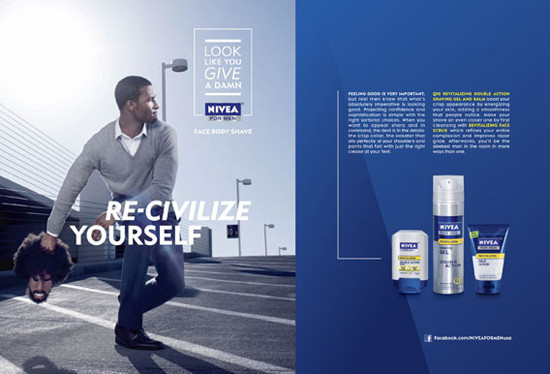
Arguably one of the most controversial industries, Advertising has drawn a lot of criticism for its use of inappropriate even racist stereotypes. Ads like NIVEA's 'Look Like You Give a Damn' campaign have caused outrage for their apparent racism. Featuring a clean-shaven African American man throwing away a mask of a 'caveman' unshaven version of himself, the ad has been interpreted to imply that his natural/ethnic hair is somehow uncivilized. 


Similarly, American Apparel featured an ad on their website of a model holding onto a Hispanic farmer which drew outrage from the Hispanic American community for stereotyping Hispanic American farmers. 


One justification for the use of racial stereotypes is illustrated in Erving Goffman's concept of "commercial realism" in which Advertising presents the advertising world in a way that is consistent with the real world. In a way, the claim suggests that advertisements are a mirror reflecting back the realities of society - both the good and the bad. By employing the use of stereotypes, the advertiser can communicate implicit meaning to the consumer simply and quickly. While this in no way justifies the commodification of racial stereotypes, could it then be suggested that advertisements are seen as racist because we as a society are racist? 

In the past few years, we have found a myriad of advertisements that seek to defy traditional concepts of race. And rather than being celebrated, these ads have received a shocking racial backlash. Cheerios released a 30-second ad featuring a mix-raced girl "Gracie".


Both heartwarming and forward-thinking, the ad elicited inappropriate and racist comments on YouTube, expressing "shock" that the 'black' father has stayed with the family, or disdain upon finding out the mother is 'white'. While there were also comments expressing grattitude to Cheerios for featuring a biracial family, the shocking response from many viewers suggest that even when an advertisement attempts to portray a stereotype that is not in-line with what is perceived as the "norm" for many individuals, there is a backlash. 

This was also the case more recently in the 2014 Coca-Cola Superbowl ad "America is Beautiful".In the ad, various Americans from a myriad of ethnic backgrounds sing the patriotic song "America the Beautiful" in their native tongues. 


While it was meant to celebrate the "multi-racial" melting pot of America (the country of immigrants), many Twitter and Facebook commenters expressed disdain calling the ad "unpatrioic", "disgraceful", even suggesting immigrants "speak English or go home". The ad challenges the conventional image of an American as a "monolingual" Caucasian. And in defying that stereotype and producing an image of the American society as multi-racial, the ad faced backlash. If advertisements are a mirror of society, both through employing inappropriate racial stereotypes and embracing cultural diversity in a society, what does that say about us as a society? And more importantly, what do our reactions and interpretations of these ads say about us?

Monday, August 4, 2014

Chick Fil-A: 'Eat Mor Chikin'

Exactly one year ago I stepped into Chick Fil-A for the first time and my life was changed. Okay, maybe that was a bit dramatic.. but you need to understand that as a marketing fanatic and lover of sandwiches, I was ecstatic to find both in one place. While I gobbled (yes, because that is how quickly I ate) this sandwich, I  came across one of the wittiest strategic marketing campaigns I have ever seen.


Let's dissect this image further, shall we?

America is renowned for its plethora of fast-food restaurants with revenue reaching 191 billion USD in 2013 (Statista, 2014) easily making it the largest market for fast-food in the world. Dominated by fast-food giants from the likes of McDonald's, Subway, and Yum! Brands (KFC, Pizza Hut, Taco Bell, etc) the industry is heavily speculated by market researchers to be in the mature stage of its life cycle. In such a large market dominated by big players like McDonald's what chances does a small fast-food chain have?

One of the fascinating things about Chick Fil-A's marketing strategy has been its ability to analyse their competitors and strategically position themselves as a niche fast-food chain.


Using Peter Drucker's theory that there are three levels of a product, one can see how Chick Fil-A has assessed themselves in relation to their competitors. As an augmented product, Chick Fil-A's offerings can be seen as a general service that can entertain or satisfy similar needs. For example: diners, restaurants, and even movie theatres and amusement parks. The Actual product, on the other hand, would be related to the fast food industry: McDonald's, Wendy's, Yum! Brands, etc. What distinguishes Chick Fil-A's marketing strategy from other fast-food restaurants is how they define their core product: a CHICKEN fast-food restaurant. By defining their core product in this way, Chick Fil-A separates themselves from the McDonald's and the Subways of this world and severely shortens their list of direct competitors to the likes of Kentucky Fried Chicken (KFC) and Popeyes Louisiana Kitchen. 

Once this simple product strategy was defined, Chick Fil-A went on to design a marketing campaign to communicate this message. Featuring a cow holding up a witty sign that says 'Eat Mor Chikin', the campaign differentiates Chick Fil-A from the traditional beef/cow-based fast food restaurant (e.g. McDonald's, Burger King, Taco Bell, etc.). In addition to adding some sass and humour anyone in the family can appreciate, the ad communicates the product strategy perfectly. And what of the cow? The cow continues to be featured in equally comical billboards becoming an icon of the brand; the Ronald McDonald or Jared of Chick Fil-A. 


Wednesday, July 23, 2014

Gender Stereotyping in Marketing - A Curious Double Standard

We hear a lot about Gender Stereotyping in Marketing. The 'princessification of children's toys', for example, where toys that used to be relatively gender neutral, are 'princessifying' themselves for little girls, or making themselves hyper-masculine for little boys. Social Anthropoligsts such as Erving Goffman have made the argument that in gender stereotyping, we are socially constructing the concept of two distinct, mutually exclusive genders - ascribing roles and codes of behaviour to impressionable, developing children.


Similarly, in the Beer industry, a growing interest in women drinkers led many brewers to target women drinkers with overtly feminine new beers designed to look like an accessory or some form of make-up bottle they could easily put in their purse. 


While the intention may have been to make the traditionally male-dominant beer industry more accessible to women, the products themselves seemed largely contrived. Will using a cursive font and plastering the colour pink onto a product really make women buy it? Unsurprisingly, many of these products were not welcomed with open arms as many women found the designs mildly sexist.

In a curious double standard, men seem to be welcoming efforts by the traditionally female-dominant grocery foods industry to reach out to the grocery shopping "Manfluencers" (Wall Street Journal). Yogurt, for example has traditionally been characterised in grocery store aisles by their feminine, light (pastel, white, pink) coloured packaging. Chobani, an American yogurt company, has recently addressed this issue, designing a male- targeted yogurt 'Powerful Yogurt' 


Featuring a bull mascot and red and black packaging, Powerful Yogurt boasts more protein than its 'feminine' alternatives. While it is overtly gender stereotyped to appeal to men, Chobani's Powerful Yogurt seems to be gaining quite the following - lovingly nicknamed "Brogurt".

These varying reactions to the same concept of gender stereotyping lead me to question. Is there a double standard? Is it somehow okay to use the hyper-masculine stereotype to appeal to men and not okay to use overly feminine stereotypes to appeal to women? And if so, does the problem lie with the product decisions or is it some form of commercial realism, presenting what we as our respective genders generally prefer?

I-95 - My East Coast Journey from New York to Savannah, GA

I always know where to eat. I personally think finding the perfect restaurant is one of the best applications of my research and analytical ...